
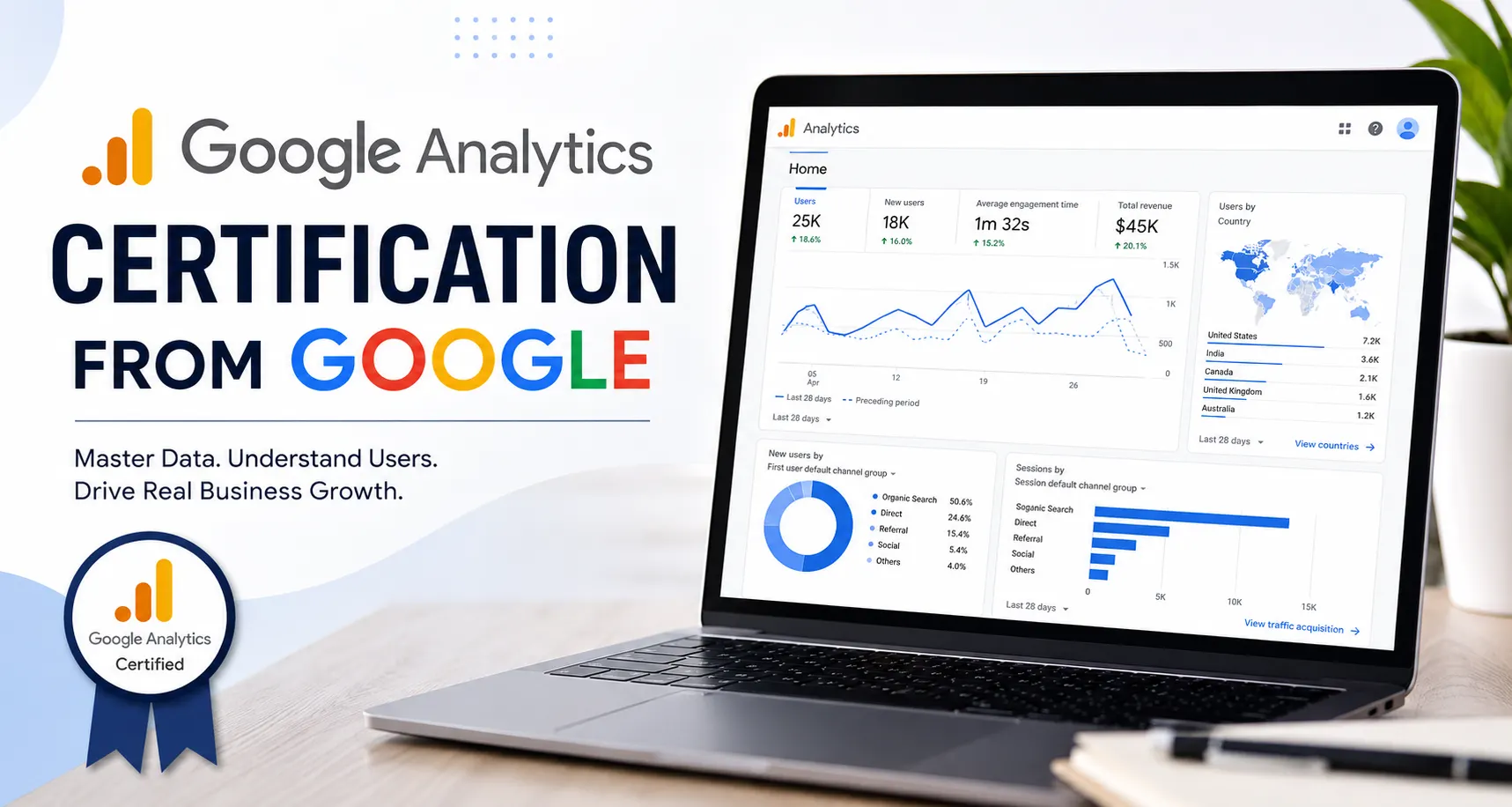
Recently, I completed the Google Analytics Certification from Google to strengthen my understanding of website analytics, audience tracking, reporting, and data-driven marketing strategies. This certification helped me gain practical knowledge of how businesses track users, measure campaign performance, identify growth opportunities, and improve digital marketing decisions using real analytics insights.
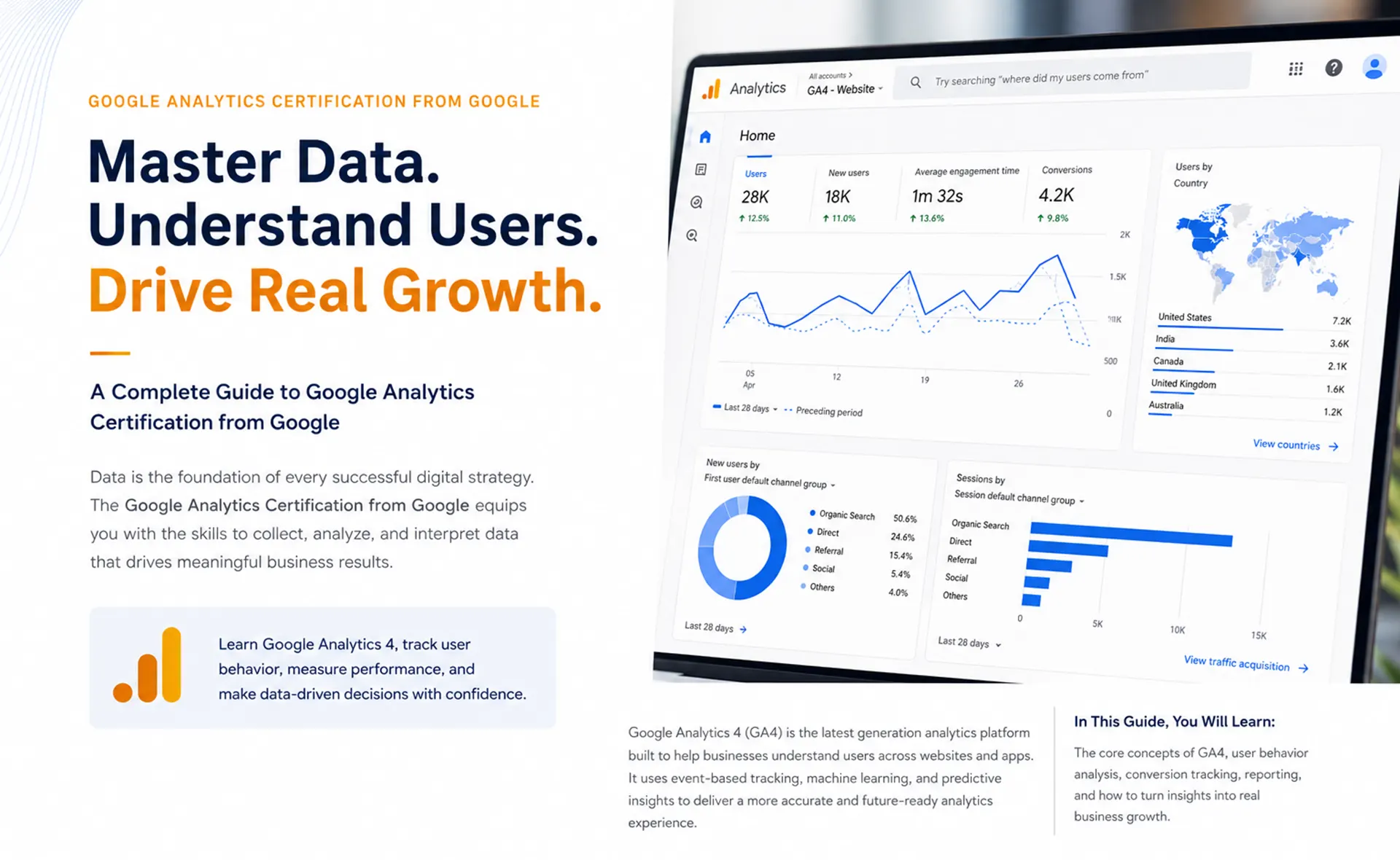
The certification focuses on Google Analytics 4, commonly known as GA4, which is the latest analytics platform developed by Google. Unlike older analytics systems that mainly focused on page views and sessions, GA4 is built around event-based tracking. This modern approach allows marketers and business owners to understand user behavior more accurately across websites and applications.
Learning Google Analytics is not only useful for analytics professionals. It is equally important for SEO specialists, PPC marketers, content marketers, web developers, eCommerce businesses, and companies that want measurable online growth. Today, almost every business website depends on analytics to understand traffic sources, customer journeys, conversions, and user engagement.
This certification gave me a stronger understanding of how digital marketing performance is measured in practical business environments. It also improved my ability to interpret data instead of simply collecting it.
Understanding the Importance of Google Analytics
Many websites receive traffic but fail to understand what users are actually doing after landing on the site. High traffic alone does not guarantee business growth. If visitors leave quickly, do not engage with content, or fail to convert, then the traffic has little business value.
Google Analytics helps solve this problem by providing detailed insights into user behavior. It allows businesses to understand where users come from, which pages perform best, how users interact with content, and what actions lead to conversions.
During the certification program, I learned how analytics supports smarter decision making in digital marketing. Instead of relying on assumptions, businesses can use data to optimize campaigns, improve website performance, and increase return on investment.
For example, analytics data can reveal whether organic search traffic is generating conversions, whether paid advertisements are attracting quality users, or whether certain landing pages are causing visitors to leave. These insights are critical for improving marketing performance.
The certification also highlighted the importance of customer journeys. Modern users interact with businesses across multiple devices and platforms. A user may discover a website through social media, return later through search engines, and finally convert through an email campaign. Google Analytics helps track these interactions to provide a clearer understanding of how conversions happen.
Introduction to Google Analytics 4
One of the most valuable parts of the certification was learning the structure and functionality of Google Analytics 4. GA4 is significantly different from Universal Analytics, which many marketers previously used.
GA4 focuses on event-driven data collection. Every user interaction can be tracked as an event, including page views, clicks, scrolls, downloads, purchases, and video engagement. This flexible tracking model provides more accurate behavioral insights compared to older session-based analytics systems.
The certification explained how GA4 uses machine learning and predictive analytics to provide smarter insights. Businesses can identify trends, predict potential customer behavior, and improve marketing strategies using data-driven forecasting.
I also learned how GA4 improves cross-platform tracking. Since users often move between mobile devices, tablets, and desktops, businesses need analytics systems capable of tracking users across different environments. GA4 is designed to handle this more effectively.
Privacy and data regulations were another important topic covered during the course. As online privacy becomes more important globally, analytics tools must adapt to changing regulations and reduced cookie dependency. Google Analytics 4 introduces more privacy-focused measurement methods while still providing useful business insights.
Skills I Gained Through the Certification
The Google Analytics Certification helped me build both technical and strategic skills related to digital marketing analytics.
One major area of learning was account and property setup. I learned how businesses structure analytics accounts, configure data streams, and organize reporting environments correctly. Proper setup is essential because inaccurate configuration can lead to misleading data.
Another important skill was event tracking. Understanding how events work in GA4 is critical for measuring user behavior. I learned how businesses track important interactions such as form submissions, button clicks, purchases, and engagement actions.
Audience analysis was another valuable topic. The certification taught me how businesses segment users based on demographics, behavior, acquisition channels, and engagement patterns. Audience segmentation helps marketers create more targeted campaigns and personalized experiences.
I also gained knowledge about traffic acquisition reporting. Businesses need to know which channels generate the best results. Google Analytics allows marketers to compare traffic from organic search, direct visits, paid advertisements, referral websites, social media, and email campaigns.
Conversion tracking was one of the most practical areas of the course. Businesses ultimately care about measurable actions such as purchases, lead submissions, bookings, or registrations. I learned how conversions are configured and measured within GA4.
The certification also improved my reporting skills. Raw data alone has limited value if it cannot be interpreted correctly. I learned how to analyze reports, identify patterns, detect problems, and present insights that support business decisions.
The Role of Google Analytics in SEO
As someone interested in digital marketing and SEO, one of the most valuable aspects of this certification was understanding how analytics supports search engine optimization strategies.
SEO is not only about rankings. Rankings matter, but business performance matters more. Google Analytics helps SEO professionals measure whether organic traffic is generating engagement, conversions, and actual business results.
Through the certification, I learned how analytics can identify high-performing landing pages, user engagement trends, bounce patterns, and conversion behavior from organic traffic. These insights are essential for improving SEO strategies.
For example, if a webpage ranks well but users leave quickly, that may indicate poor content quality, weak user experience, or mismatched search intent. Analytics data helps identify these issues.
I also learned how analytics supports content optimization. By analyzing engagement metrics, marketers can understand which content topics attract users, how long visitors stay on pages, and which pages encourage further interaction.
Another important concept was tracking user journeys. SEO traffic often contributes to multi-step conversion paths rather than direct conversions. Google Analytics helps businesses understand how organic traffic supports the overall marketing funnel.
This certification strengthened my understanding that successful SEO requires both visibility and performance measurement.
Learning About User Behavior and Engagement
One of the strongest features of Google Analytics is its ability to reveal user behavior patterns. Understanding how visitors interact with a website helps businesses improve usability, content structure, and conversion performance.
During the certification, I learned how engagement metrics provide deeper insights into website performance. Metrics such as engagement rate, average engagement time, and event interactions help measure the quality of user activity.
User behavior analysis can identify pages where visitors lose interest, navigation problems that reduce engagement, or content sections that perform exceptionally well.
The certification also explained the importance of funnel analysis. Businesses often want users to follow specific paths, such as visiting a product page, adding items to a cart, and completing a purchase. Analytics helps identify where users abandon the process.
Understanding these patterns is important because even small improvements in user experience can significantly increase conversion rates.
Conversion Tracking and Business Growth
One of the biggest mistakes businesses make is focusing only on traffic numbers instead of business outcomes. Large visitor counts may look impressive, but they are meaningless if they do not generate leads, sales, or engagement.
Google Analytics helps businesses measure actual performance through conversion tracking.
The certification explained how conversions can represent different business goals depending on the website. For an eCommerce store, conversions may include purchases. For a service business, conversions may include contact form submissions or phone calls. For content websites, conversions may involve newsletter signups or content downloads.
I learned how businesses use conversion data to evaluate marketing effectiveness. If one traffic source generates more conversions than another, marketers can adjust budgets and strategies accordingly.
This analytical approach improves efficiency because decisions are based on measurable performance instead of assumptions.
The certification also emphasized attribution models, which help businesses understand how different marketing channels contribute to conversions. Modern customer journeys are complex, and attribution analysis helps identify the true value of each marketing effort.
Reporting and Data Interpretation
Analytics data becomes useful only when it is interpreted correctly. One of the key lessons from the certification was understanding how to convert raw numbers into actionable insights.
Google Analytics provides various reports that help businesses monitor audience behavior, traffic sources, engagement metrics, and conversion performance.
I learned how to analyze reports to identify trends, opportunities, and weaknesses. For example, a sudden drop in organic traffic may indicate technical SEO issues, algorithm updates, or tracking problems. High exit rates on important pages may suggest poor user experience or irrelevant content.
The certification also explained how custom reports and explorations allow businesses to analyze data more deeply. Advanced reporting helps marketers answer specific business questions rather than relying only on default dashboards.
Another important learning area was data visualization and communication. Businesses often need analytics insights presented clearly for decision-making. Understanding how to explain data effectively is an essential skill for digital marketers.
Why This Certification Matters for Recruiters
The Google Analytics Certification demonstrates more than basic tool knowledge. It shows an understanding of data-driven marketing, analytical thinking, and performance measurement.
Recruiters increasingly look for candidates who can combine marketing knowledge with analytical skills. Modern digital marketing requires measurable strategies, not just creative execution.
This certification validates my ability to work with website analytics, understand user behavior, track conversions, and evaluate campaign performance using industry-standard tools.
It also demonstrates familiarity with GA4, which has become the primary analytics platform used by businesses globally. Since many organizations are transitioning fully to Google Analytics 4, practical GA4 knowledge is now highly relevant in the digital marketing industry.
For SEO and digital marketing roles, analytics knowledge is no longer optional. Employers want professionals who can interpret performance data, identify growth opportunities, and support strategic decision-making.
Completing this certification strengthened my understanding of how businesses use analytics to improve marketing efficiency, optimize user experience, and increase conversions.
Real-World Application of Google Analytics Knowledge
The value of analytics knowledge becomes clear when applied to real business situations. Throughout the certification, the practical use cases showed how businesses rely on analytics for continuous improvement.
For example, eCommerce companies use analytics to track product performance, shopping behavior, and checkout abandonment. Service businesses analyze lead generation performance and customer acquisition sources. Content publishers measure engagement and audience retention.
Analytics also plays a major role in paid advertising optimization. Marketers use conversion data and audience insights to improve campaign targeting and budget allocation.
In SEO projects, analytics helps identify high-performing pages, keyword opportunities, and content gaps. Instead of making random optimization decisions, marketers can prioritize improvements based on actual user behavior data.
The certification reinforced the idea that analytics is not simply about generating reports. Its real purpose is improving decision-making and business performance.
Final Thoughts
Completing the Google Analytics Certification from Google was an important step in strengthening my digital marketing and analytics knowledge. The certification provided practical understanding of Google Analytics 4, user behavior analysis, event tracking, audience segmentation, reporting, and conversion measurement.
More importantly, it helped me understand how businesses use data to make informed marketing decisions. Modern digital marketing depends heavily on analytics because successful strategies require measurable performance, not assumptions.
This certification improved my ability to analyze website performance, interpret user behavior, track marketing effectiveness, and support data-driven optimization strategies. It also strengthened my understanding of how SEO, content marketing, paid advertising, and user experience connect through analytics insights.
As businesses continue prioritizing measurable growth and customer-focused marketing, analytics skills will remain highly valuable across the digital industry. The knowledge gained from this certification provides a strong foundation for understanding digital performance and improving online marketing strategies effectively.