If you have a website, you’ve probably heard the term SEO many times. But what exactly is SEO, and why is it so important? In this beginner friendly guide, you’ll understand everything you need to know about SEO, how it works, and how you can start using it to grow your website.
What is SEO?
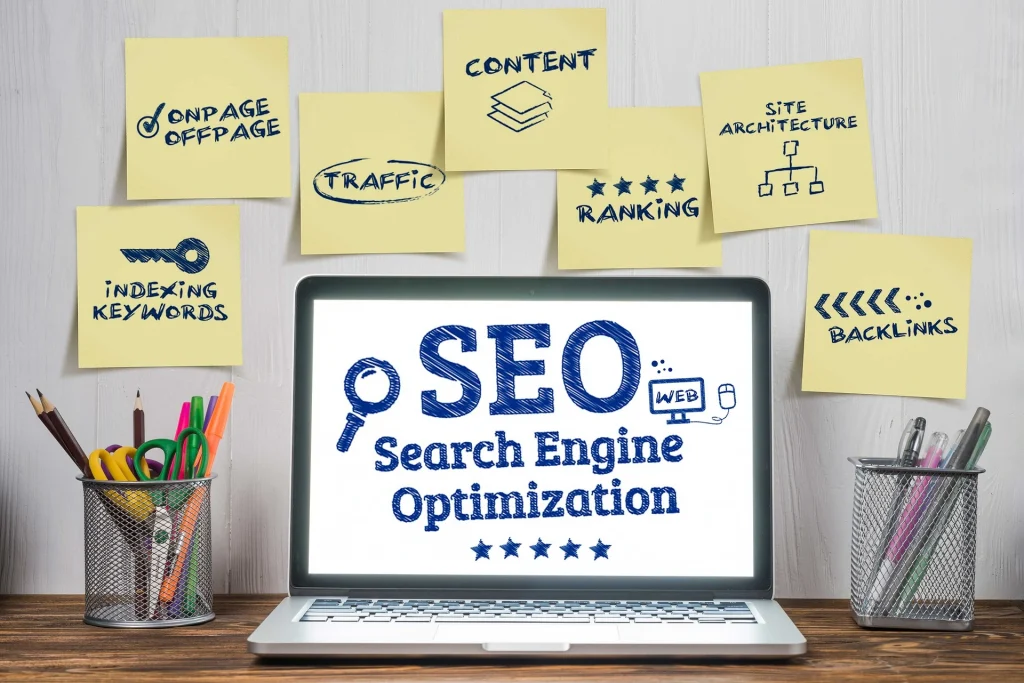
SEO (Search Engine Optimization) is the process of improving your website ranking on search engines like Google, Yahoo for better visibility.
In simple words SEO helps your website ranking higher on SERP (Search Engine Result Page) when someone search for content that related to your content. The higher your pages appear in search results, the greater the chance they are discovered and clicked on.
Example: if someone searches “What is SEO”, Google shows thousands of results. SEO determines which ones appear on page 1 and which ones stay invisible.
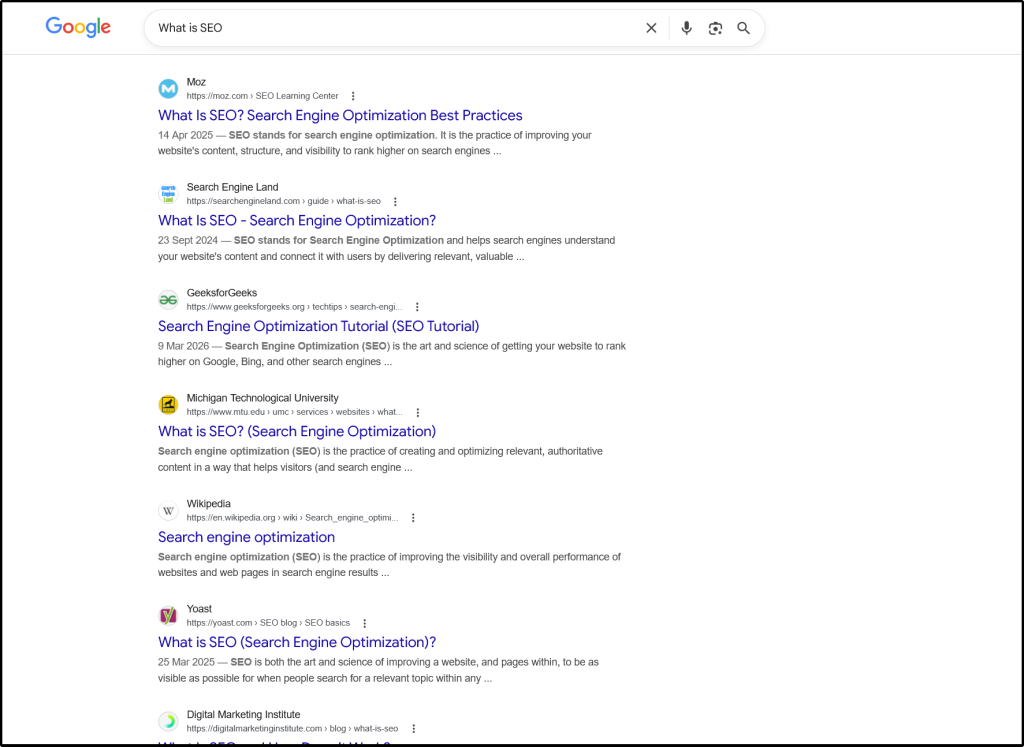
Google shows results it believes are:
- Relevant
- Helpful
- Trustworthy
Your job is to prove your content deserves to be there.
Why is SEO So Important?
SEO is important because it brings free organic traffic to your website every month and If you’re not on the first page of Google, you’re almost irrelevant.
Here’s why SEO matters:
1.Organic Traffic or Free Traffic
Unlike paid ads, you don’t have to pay for each click. Paid ads bring instant traffic but stop paying, and it’s gone. SEO builds long-term traffic that compounds over time.
2. High Intent Users
When someone needs a product, service, or information, they go straight to Google. If your website shows up for these searches, you can attract visitors actively looking for what you offer. SEO targets users actively searching for solutions.
3. Trust and Credibility
Users trust Google. If you rank high, they assume you’re credible even if you’re not the biggest brand because people generally trust organic results more than ads.
4. Better ROI Than Ads
SEO takes time, but once you rank well you can get consistent organic traffic without paying for visitors and your cost per visitor drops significantly.
5. Competitive Advantage
If your competitors are investing in SEO and you’re not, you’re already behind.
How Search Engines Work?
Most people try SEO without understanding how search engines operate. That’s like trying to win a game without knowing the rules.
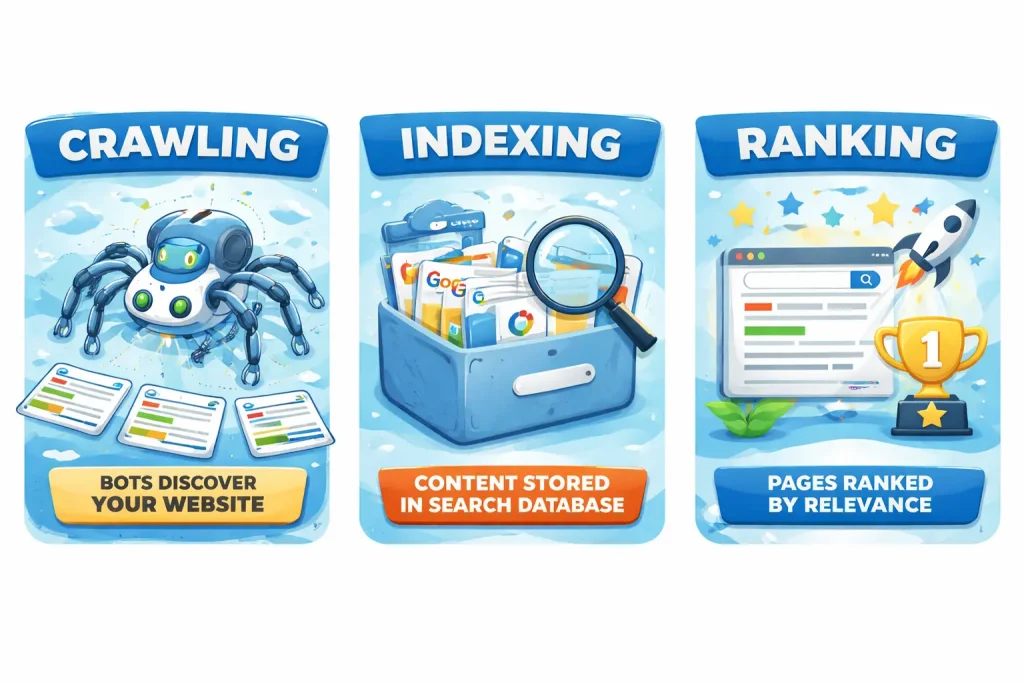
Search engines follow a 3-step process:
1. Crawling
Search engines, like Google, use automated bots (spiders or crawlers) to navigate the web. These bots follow links from one page to another, discovering and indexing content on websites. If your website has broken links, poor structure, blocked pages crawlers may miss your content completely.
2. Indexing
Once a page is crawled, its content is analyzed and stored in the search engine’s index, a massive database of web content. Indexed pages can appear in search results when users enter relevant queries.
3. Ranking
After indexing, search engines rank pages based on relevance, quality, Authority (backlinks) and user experience. Pages that best match a search query appear higher in results, driving more clicks.
Your goal with SEO is to help search engines understand your content better so they rank it higher.
Types of SEO
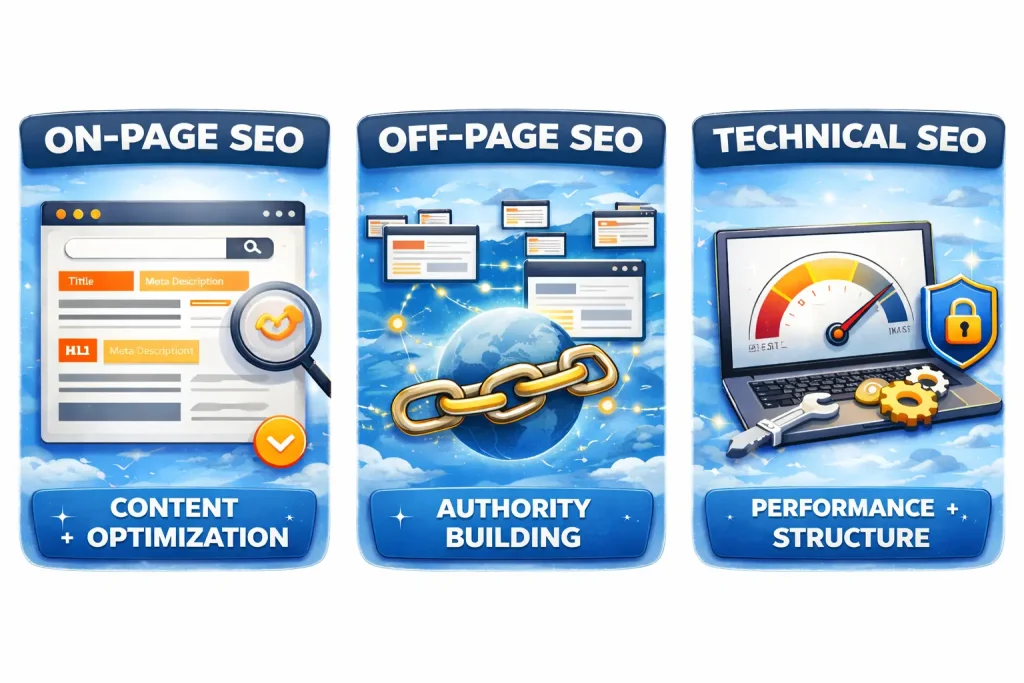
There are three main types of SEO you should know:
1. On-Page SEO (Content Optimization)
This is everything you control directly on your website.
Includes:
- Titles and meta descriptions
- Headings (H1, H2, H3)
- Keyword usage
- Content quality
- Internal linking
Just adding keywords won’t help. If your content is weak, you won’t rank.
2. Off-Page SEO (Authority Building)
This focuses on building your website’s authority.
- Backlinks
- Social media sharing
- Brand mentions
Backlinks act like votes of confidence. But not all votes are equal:
3. Technical SEO
This ensures your website works properly.
- Fast loading speed
- Mobile friendly design
- Secure website (HTTPS)
- Proper site structure
- Proper indexing
If your site is slow or hard to use, users leave and rankings drop.
There are other important types of SEO you need to know:
4. Local SEO
Local SEO focuses on optimizing your business to appear in location-based searches. Example: “digital marketing agency near me”
It helps businesses rank in:
- Google Maps
- Local search results
Key factors:
- Google Business Profile
- Local keywords
- Reviews and ratings
Best for: Local businesses, shops, service providers
5. Mobile SEO
Mobile SEO ensures your website works perfectly on smartphones and tablets.
Since most users browse on mobile, Google uses mobile-first indexing.
Key factors:
- Responsive design
- Fast loading speed
- Easy navigation
If your site isn’t mobile-friendly, your rankings will drop.
6. Voice SEO
Voice SEO optimizes your content for voice searches using assistants like Google Assistant or Alexa.
Example: “What is SEO in simple words?”
Key factors:
- Conversational keywords
- Question-based content
- Featured snippets
Voice searches are growing fast, especially on mobile devices.
7. Image SEO
Image SEO helps your images rank in Google Image search and improves overall SEO.
Key factors:
- Alt text (image description)
- File name optimization
- Image size and speed
Optimized images can drive extra traffic from search engines.
8. E-commerce SEO
E-commerce SEO focuses on optimizing online stores to increase product visibility and sales.
Key areas:
- Product page optimization
- Category pages
- Reviews and ratings
- Schema markup
Goal: Turn traffic into buyers.
9. Enterprise SEO
Enterprise SEO is for large websites with thousands (or millions) of pages.
Used by:
- Big companies
- Large e-commerce sites
- News portals
Focus areas:
- Scalable SEO strategies
- Automation
- Technical optimization
Requires advanced tools and structured workflows.
10. International SEO
International SEO helps your website rank in different countries and languages.
Key elements:
- Language targeting
- Country-specific domains
- hreflang tags
Example: Showing different content for India, US, or UK users.
How SEO Actually Works
SEO is not random. It’s a structured process.
Step 1: Keyword Research
Find what your audience is searching for.
Examples:
- “What is SEO”
- “SEO beginner guide”
- “How to rank on Google”
Beginner-friendly tools:
- Google Keyword Planner
- Ubersuggest
Mistake: Targeting high-competition keywords too early.
Step 2: Understand Search Intent
This is where most people fail.
Ask:
Why is the user searching this?
Types of intent:
- Informational (learn something)
- Navigational (find a specific site)
- Transactional (buy something)
If your content doesn’t match intent, it won’t rank.
Step 3: Create High-Quality Content
Content must:
- Solve a real problem
- Be easy to read
- Provide depth
- Offer unique insights
Harsh truth: AI-generated generic content is flooding the internet. Only valuable content stands out.
Step 4: On-Page Optimization
Once content is ready:
- Use primary keyword in title
- Include keyword in introduction
- Add headings properly
- Optimize images (alt text)
- Use internal links
Step 5: Build Backlinks
Without backlinks, ranking in competitive niches is difficult.
Methods:
- Guest blogging
- Outreach
- Creating shareable content
Avoid shortcuts like buying cheap backlinks.
Step 6: Track and Improve
SEO is ongoing.
Use:
- Google Analytics
- Google Search Console
Track:
- Traffic
- Rankings
- CTR
- Bounce rate
White-Hat SEO vs Black-Hat SEO
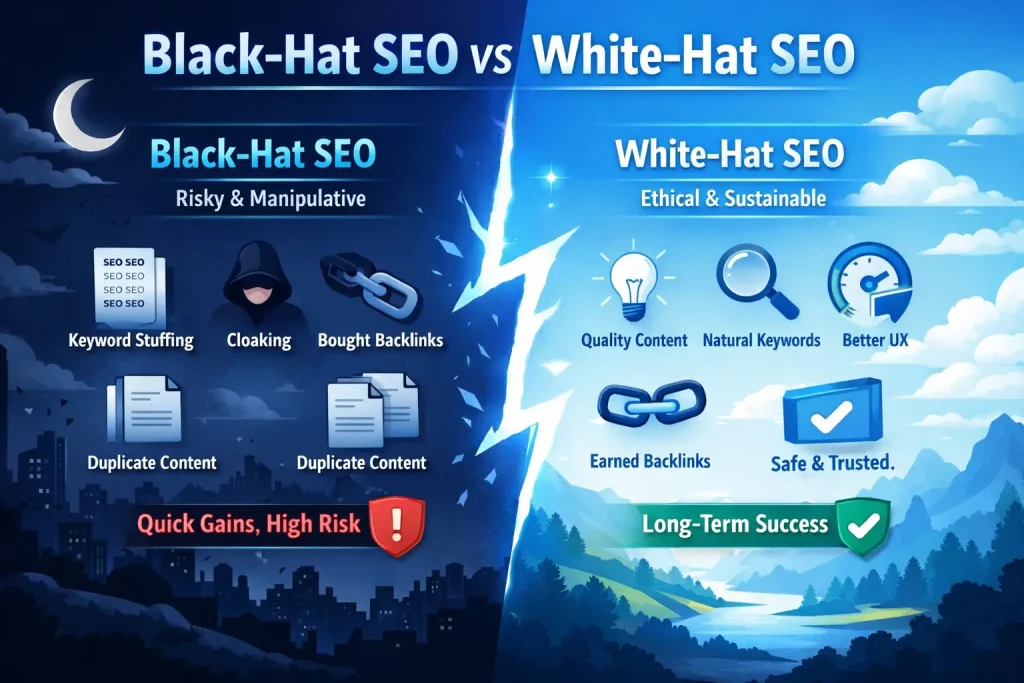
In SEO, not all strategies are created equal. Broadly, techniques fall into two categories: White-Hat SEO and Black-Hat SEO. Understanding the difference is critical if you want long-term results instead of short-lived gains.
White-Hat SEO (Ethical & Sustainable)
White-Hat SEO refers to optimization techniques that follow search engine guidelines and focus on delivering real value to users. It’s the approach Google actually wants you to take.
Key practices include:
- Creating high-quality, original content
- Optimizing keywords naturally
- Improving website speed and user experience
- Building genuine backlinks
White-Hat SEO takes time, but it builds trust, authority, and long-term rankings. Websites using this approach are less likely to face penalties and more likely to sustain consistent growth.
Black-Hat SEO (Risky & Manipulative)
Black-Hat SEO involves tactics that try to manipulate search engine algorithms for quick rankings. These methods ignore user experience and focus only on exploiting loopholes.
Common techniques include:
- Keyword stuffing
- Cloaking (showing different content to users and search engines)
- Buying low-quality backlinks
- Duplicate or spun content
While Black-Hat SEO can deliver fast results, it comes with serious risks. Search engines are constantly updating their algorithms, and once detected, your website can face penalties, ranking drops, or even complete removal from search results.
What are Keywords in SEO?
Keywords in SEO are the core terms that define what your content is about and help search engines match it with user queries. They are essentially the language of search—what people type into Google when they need answers, solutions, or products. Without the right keywords, even high-quality content can remain invisible.
But keywords are not just about traffic—they’re about relevance. A well-chosen keyword aligns your content with the exact needs of the user. For example, someone searching “learn SEO basics” expects a beginner-friendly guide, not an advanced technical breakdown.
There are different types of keywords you should understand:
- Short-tail keywords: Broad and high competition (e.g., “SEO”)
- Long-tail keywords: Specific and easier to rank (e.g., “what is SEO for beginners”)
- Intent-based keywords: Focused on user goals (informational, transactional, etc.)
Effective SEO uses keywords strategically in titles, headings, and content while keeping the writing natural and user-focused. Overusing or forcing keywords can hurt rankings, as search engines now prioritize context and quality over repetition.
In simple terms, keywords guide both users and search engines—helping your content get discovered by the right audience at the right time.
What is Keyword Research?
Keyword research is the process of identifying the exact words and phrases your target audience uses when searching on search engines. It is the foundation of SEO because it guides what content you should create and how you should optimize it to attract the right traffic.
At its core, keyword research is not just about finding popular terms—it’s about understanding demand, competition, and user intent. Without proper research, you’re essentially guessing what your audience wants, which often leads to content that doesn’t rank or convert.
A strong keyword research process focuses on:
- Search intent: Understanding why users are searching (informational, navigational, or transactional)
- Search volume: How many people are searching for a keyword
- Keyword difficulty: How hard it is to rank for that term
- Relevance: How closely the keyword matches your content or business
Effective keyword research also involves finding long-tail keywords, which are more specific and less competitive, making them ideal for beginners.
When done correctly, keyword research helps you create content that answers real user queries, improves your chances of ranking on search engines, and drives targeted traffic to your website. It turns content creation from guesswork into a data-driven strategy that delivers consistent results.
Conclusion
SEO is not a shortcut to instant success—it’s a long-term strategy that rewards consistency, clarity, and real value. By now, you should understand that ranking on search engines isn’t about tricking algorithms, but about aligning your content with what users are genuinely searching for.
If you strip everything down, effective SEO comes down to doing a few things exceptionally well:
- Understanding your audience and their search intent
- Choosing the right keywords based on data, not assumptions
- Creating content that is genuinely helpful and better than competitors
- Optimizing your website for performance, structure, and usability
- Building authority through trust and quality backlinks
The biggest mistake beginners make is overcomplicating SEO or expecting quick results. In reality, even basic strategies—executed consistently—can outperform advanced tactics done poorly.
Search engines are evolving, especially with AI, but one thing remains constant: they prioritize useful, user-focused content. If your goal is to provide real value instead of chasing shortcuts, you’re already ahead of most competitors.
Start simple, stay consistent, and focus on improvement. SEO is not about perfection—it’s about progress.