SEO vs AEO vs GEO: Understanding the Future of Search Optimization
The digital marketing industry is changing rapidly. Traditional search engine optimization is no longer the only strategy businesses need to improve online visibility. The rise of AI-powered search engines, voice assistants, and generative AI platforms has completely transformed how users search for information online.
For years, SEO was the foundation of digital marketing. Businesses optimized websites to rank higher on search engines like Google and focused heavily on keywords, backlinks, technical SEO, and organic traffic. However, modern search behavior is changing. Users increasingly expect direct answers instead of browsing multiple websites.
This shift introduced two new concepts into digital marketing: AEO and GEO.
AEO, or Answer Engine Optimization, focuses on optimizing content for direct answers shown in search engines and voice assistants. GEO, or Generative Engine Optimization, focuses on optimizing content for AI-driven generative search platforms like OpenAI ChatGPT, Google Gemini, and Microsoft Copilot.
Many businesses still do not fully understand the differences between GEO, AEO, and SEO. As a result, they continue using outdated strategies that focus only on traditional search rankings while ignoring how AI systems now deliver information.
Understanding GEO vs AEO vs SEO is becoming essential for long-term digital visibility.
What is SEO?
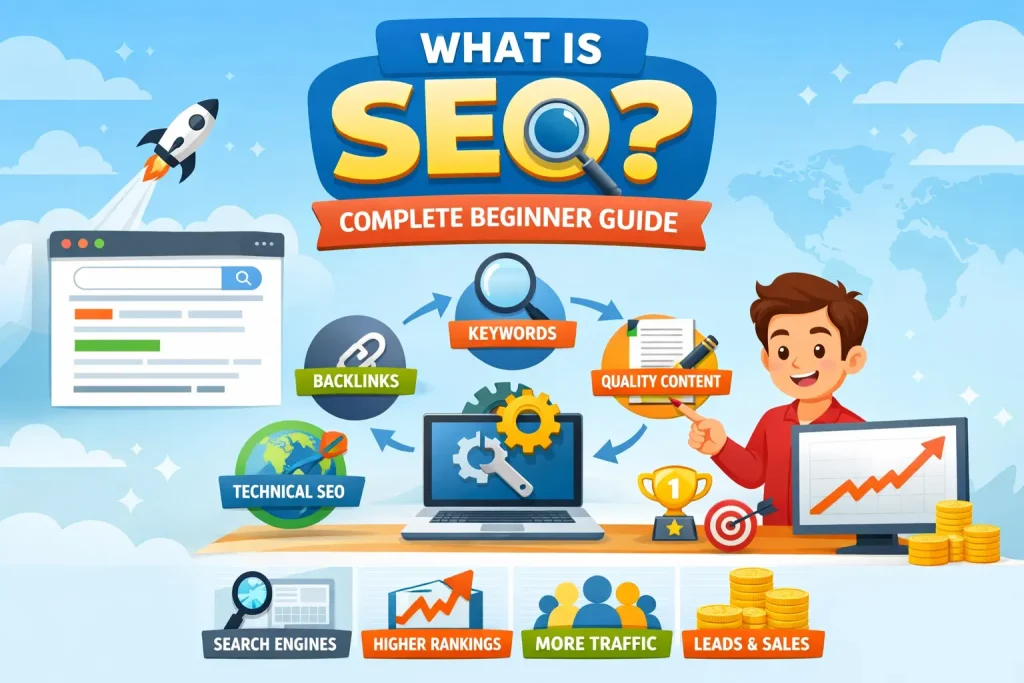
SEO, or Search Engine Optimization, is the process of improving a website’s visibility in traditional search engine results pages. The primary goal of SEO is to increase organic traffic by ranking higher for relevant search queries.
SEO involves multiple elements including keyword optimization, technical SEO, content quality, user experience, backlinks, internal linking, and mobile optimization.
For example, when users search for “best SEO tools” on Google, search engines analyze thousands of pages and rank the most relevant and trustworthy results. SEO helps websites appear among those top results.
Traditional SEO has dominated digital marketing for more than two decades because search engines originally functioned as discovery platforms. Users searched for information, and search engines provided a list of websites.
That model still exists, but it is evolving rapidly.
Search engines now prioritize direct answers, AI summaries, and conversational experiences. Instead of simply sending users to websites, they increasingly provide information directly inside search results.
This shift created the need for AEO and GEO.
How SEO Works
SEO depends on search engine crawlers and indexing systems. Search engines scan websites, understand content, evaluate authority, and determine rankings based on hundreds of factors.
Keyword relevance remains important because search engines still need to understand page topics. Technical SEO also matters because poor website performance negatively affects user experience and rankings.
Backlinks continue to work as authority signals. Websites with strong backlink profiles are generally viewed as more trustworthy.
Modern SEO is no longer about keyword stuffing or manipulating algorithms. Those outdated tactics stopped working years ago. Today, search engines prioritize valuable, trustworthy, and user-focused content.
Search intent has become one of the most important SEO factors. Search engines now attempt to understand what users actually want instead of simply matching keywords.
This shift toward semantic understanding helped create the foundation for AEO and GEO.
What is AEO?
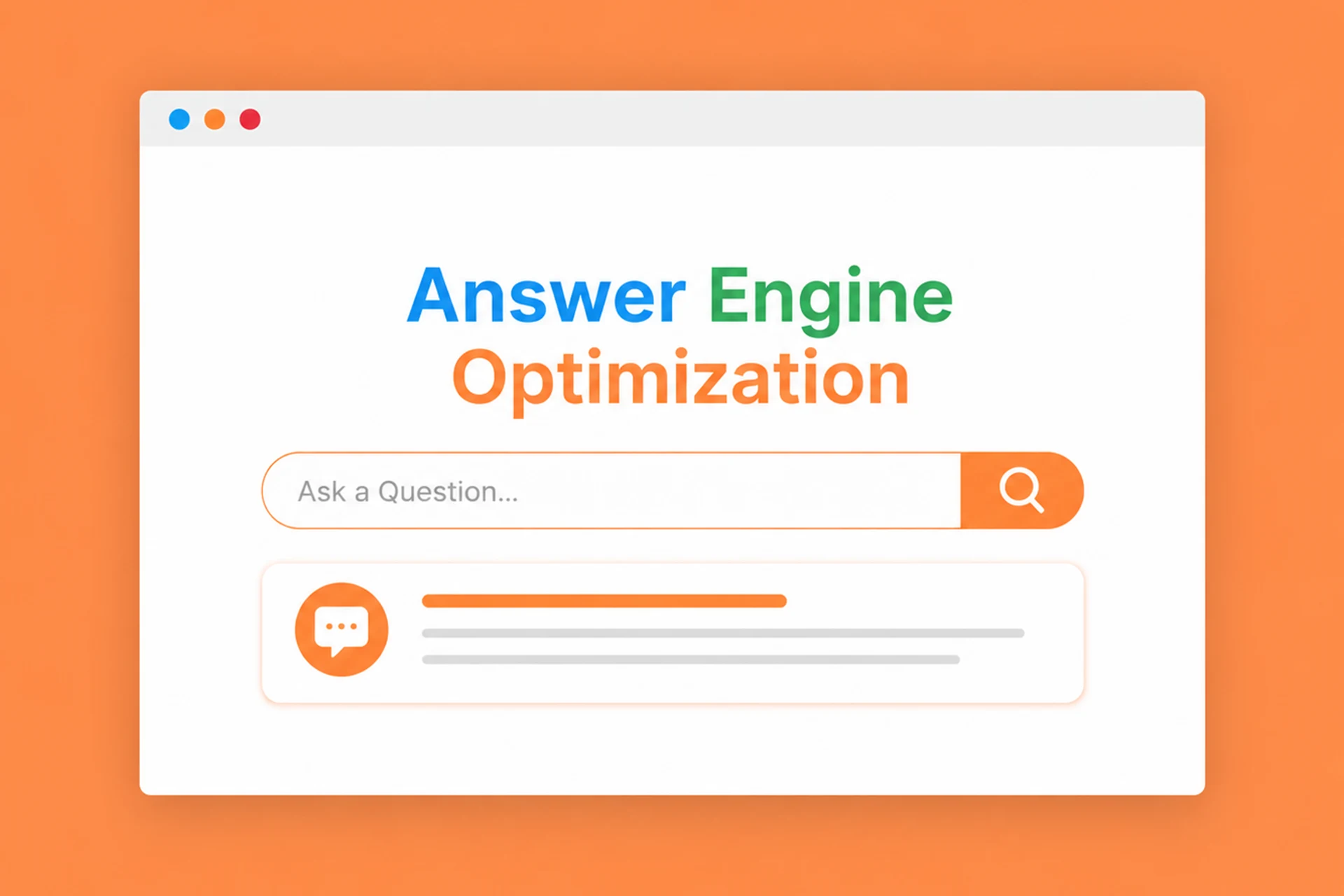
AEO, or Answer Engine Optimization, is the process of optimizing content to appear as direct answers in search engines, voice assistants, and AI-powered answer systems.
Unlike traditional SEO, which focuses mainly on rankings and clicks, AEO focuses on answer visibility.
Platforms like Google increasingly show featured snippets, AI overviews, and direct answer boxes. Voice assistants such as Amazon Alexa, Apple Siri, and Google Assistant also rely heavily on answer-focused content.
When users ask questions like “What is SEO?” or “How does email marketing work?” search engines often display direct answers immediately instead of forcing users to visit multiple websites.
AEO aims to make your content the selected answer.
This shift is driven by changing user behavior. Modern users want fast and accurate information without spending time browsing different pages.
Voice search has accelerated this trend because voice assistants typically provide only one direct answer.
How AEO Works
AEO relies heavily on structured and conversational content. Search engines prefer content that is easy to understand, extract, and present as direct answers.
Content optimized for AEO often includes question-based headings, concise explanations, FAQ sections, schema markup, and conversational language.
For example, if someone asks, “What is AEO?” search engines may pull a short paragraph directly from a webpage that clearly defines the concept.
This means content structure matters significantly.
Pages optimized for AEO usually contain clear formatting, semantic headings, natural language, and direct responses to common user queries.
Voice search also plays a major role in AEO optimization. Users speak differently than they type.
A typed query might be:
“best digital marketing agency Kolkata”
A voice query often sounds like:
“Which is the best digital marketing agency near me?”
This conversational behavior requires marketers to optimize content differently compared to traditional SEO.
AEO is essentially optimization for direct machine-readable answers.
What is GEO?
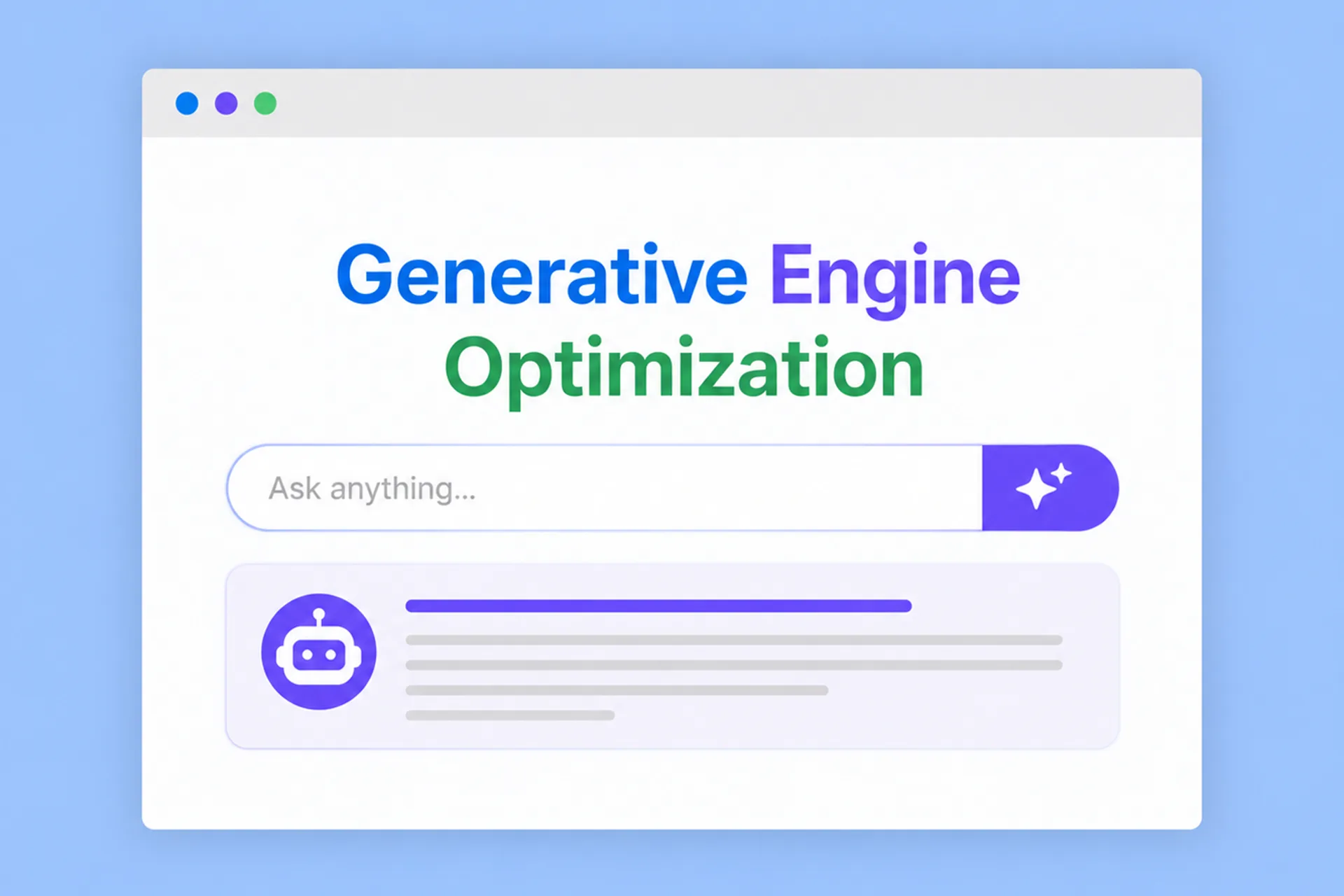
GEO, or Generative Engine Optimization, is the latest evolution in digital visibility strategy.
GEO focuses on optimizing content for generative AI systems that create conversational responses instead of displaying traditional search results.
Platforms like OpenAI ChatGPT, Google Gemini, Microsoft Copilot, and Perplexity AI are changing how users discover information online.
Instead of clicking multiple websites, users now ask AI systems questions directly. The AI generates answers by combining information from different sources.
This changes digital marketing completely.
Traditional SEO focused on rankings and clicks. GEO focuses on becoming part of AI-generated responses.
If AI systems do not recognize your content as trustworthy and authoritative, your brand may never appear inside generated answers.
That creates a new visibility challenge for businesses.
How GEO Works
GEO depends more on authority, context, and semantic understanding than exact keyword matching.
Generative AI systems prioritize content that demonstrates expertise, trustworthiness, and topical depth.
Unlike traditional SEO, GEO is less dependent on exact keywords. AI systems analyze meaning, relationships between topics, and contextual relevance.
This means shallow content performs poorly in AI-driven environments.
Many websites still publish low-quality articles designed only for search rankings. That strategy is becoming less effective because AI systems prioritize valuable and reliable information.
GEO rewards comprehensive, well-structured, and authoritative content.
Brand reputation also matters more now. AI systems analyze broader credibility signals across the internet, including mentions, expertise, citations, and content consistency.
This aligns closely with Google’s E-E-A-T principles: Experience, Expertise, Authoritativeness, and Trustworthiness.
SEO vs AEO vs GEO: Core Differences
The biggest mistake marketers make is assuming GEO, AEO, and SEO are identical strategies.
They are connected, but they serve different purposes.
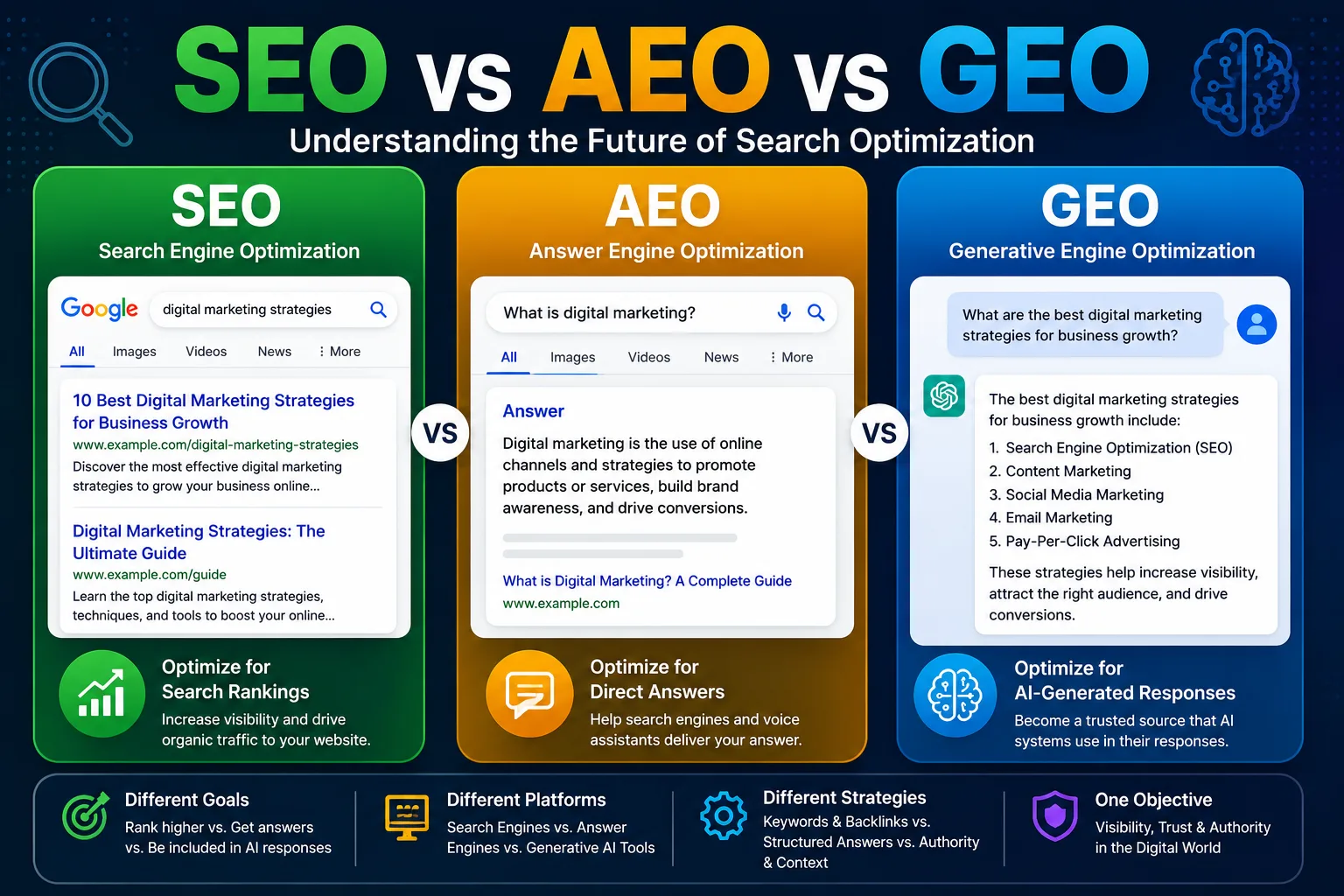
SEO focuses on improving rankings in traditional search engines.
AEO focuses on appearing as direct answers.
GEO focuses on becoming part of AI-generated responses.
SEO primarily targets search engine algorithms and organic traffic.
AEO targets answer systems and voice search platforms.
GEO targets generative AI engines and conversational interfaces.
SEO depends heavily on keywords, backlinks, technical optimization, and page experience.
AEO relies more on concise answers, structured content, and semantic formatting.
GEO depends on authority, contextual understanding, and trustworthy information.
Another major difference is user behavior.
Traditional SEO assumes users will click links and explore websites.
AEO assumes users want immediate answers.
GEO assumes users may never visit websites because AI systems generate complete responses directly.
This is one of the biggest changes happening in digital marketing today.
Why GEO Matters More Than Most Businesses Think
Many businesses still underestimate the impact of AI-driven search behavior.
That is a major strategic mistake.
AI platforms are rapidly changing how users search for information. Younger audiences especially are becoming comfortable using AI tools instead of traditional search engines.
Even Google now prioritizes AI-generated summaries through AI Overviews.
This reduces traditional click-through behavior because users can often get answers without visiting websites.
As this trend grows, businesses that rely only on SEO may experience declining traffic even if rankings remain stable.
That is why GEO matters.
Businesses that fail to optimize for generative AI systems risk becoming invisible inside AI-generated conversations.
Industries like SaaS, education, technology, finance, and digital marketing are especially vulnerable because users frequently ask AI systems informational questions related to these industries.
The Relationship Between SEO, AEO, and GEO
The smartest strategy is not choosing one over the others.
Businesses need all three.
SEO remains important because traditional search still drives enormous traffic globally.
AEO is becoming essential because users increasingly expect direct answers.
GEO is becoming critical because AI-generated search experiences are growing rapidly.
These strategies overlap in many ways.
Strong SEO improves discoverability.
Strong AEO improves answer visibility.
Strong GEO improves AI relevance.
The common foundation behind all three is high-quality content.
Low-value content struggles everywhere.
Search engines, answer engines, and AI systems are all becoming better at identifying genuinely useful information.
This is why spammy SEO tactics and low-quality AI-generated articles are becoming less effective.
How to Optimize for SEO, AEO, and GEO Together
Businesses should build integrated optimization strategies instead of treating SEO, AEO, and GEO separately.
The foundation is authoritative content.
Start by understanding user intent and creating content that genuinely solves problems. Avoid publishing shallow articles designed only around keywords.
Use clear structure with headings, semantic organization, and logical formatting.
Include direct answers for common questions to improve AEO performance.
Use schema markup because structured data helps search engines and answer systems understand content more effectively.
Build topical authority by consistently publishing content around related subjects.
Technical SEO still matters because website speed, mobile optimization, crawlability, and accessibility affect discoverability.
Brand authority is also becoming increasingly important. Mentions across reputable websites, forums, media publications, and industry discussions strengthen credibility.
Content quality is now the most important long-term advantage.
The Future of Search Optimization
The future of search will combine traditional rankings, direct answers, and AI-generated conversations.
Search behavior is becoming fragmented across multiple platforms. Users may search on Google, ask ChatGPT, use voice assistants, or explore AI-powered search tools.
Digital visibility is no longer limited to search engine rankings alone.
Businesses that continue relying only on old SEO tactics will gradually lose competitive advantage.
The future belongs to brands that combine technical optimization with expertise-driven content and strong authority signals.
This does not mean SEO is dead.
Claims like “SEO is dead” are mostly exaggerated marketing statements.
SEO is evolving, not disappearing.
That evolution now includes AEO and GEO.
Final Thoughts
The digital marketing industry is entering a major transformation phase.
Traditional SEO is no longer enough on its own. AI-powered search systems are changing how information is discovered, consumed, and trusted.
AEO emerged because users increasingly want direct answers.
GEO emerged because generative AI systems now create conversational responses instead of simply displaying website links.
Businesses that continue relying only on outdated SEO strategies risk losing visibility over time.
The future of digital marketing belongs to brands that understand how search behavior is evolving.
SEO still matters.
AEO is becoming essential.
GEO is becoming the next major competitive advantage.
Businesses that adapt early will have a stronger position as AI-driven search continues reshaping the internet and digital marketing industry.