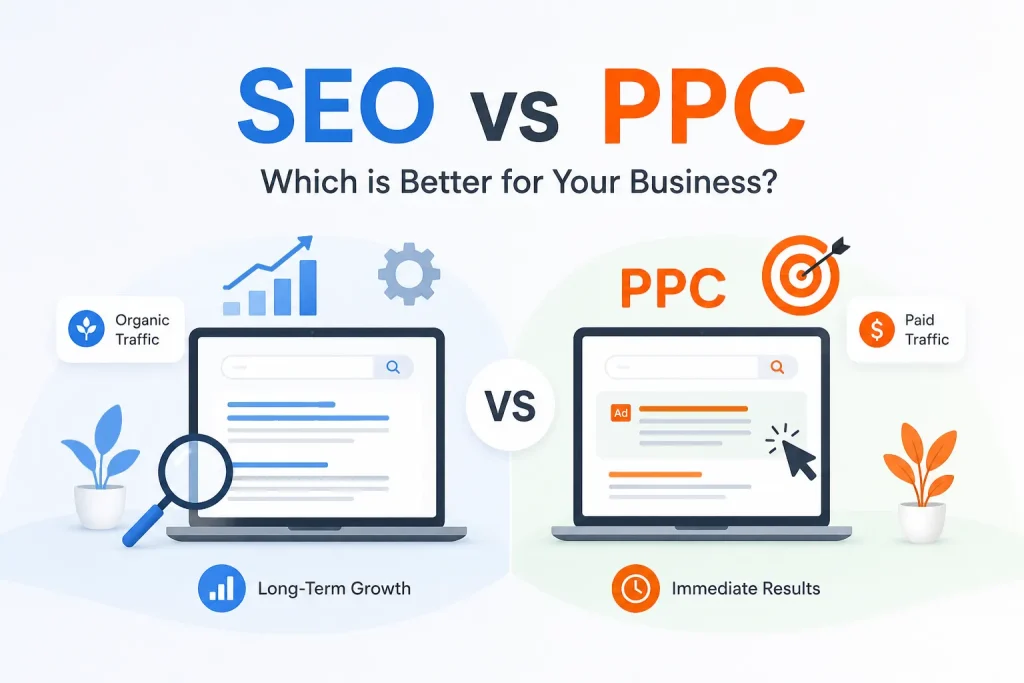
Google Ads vs Meta Ads is one of the most common discussions in digital marketing because both platforms dominate the online advertising industry. Businesses often struggle to decide where they should invest their advertising budget to achieve the best return on investment. While Google Ads focuses on capturing users who are actively searching for products or services, Meta Ads helps businesses reach potential customers through social media platforms such as Facebook and Instagram.
Understanding the strengths, weaknesses, targeting capabilities, and conversion potential of both platforms is essential for marketers and business owners. Through my learning and practical experience with digital marketing campaigns, I have gained valuable insights into how these advertising platforms work and when each platform should be used.
Understanding Google Ads
Google Ads is Google’s online advertising platform that allows businesses to display advertisements across Google’s search engine, YouTube, Gmail, Google Maps, and millions of partner websites.
The primary strength of Google Ads lies in its ability to target users based on search intent. When someone searches for a product, service, or solution, Google Ads enables businesses to appear at the top of search results, making it highly effective for generating qualified leads and conversions.
Google Ads offers multiple campaign types including Search Ads, Display Ads, Video Ads, Shopping Ads, Performance Max Campaigns, and App Promotion Campaigns. Businesses can choose campaign objectives such as website traffic, lead generation, sales, app installs, or brand awareness.
One of the biggest advantages of Google Ads is that it reaches users at the exact moment they are looking for information. This makes the platform highly suitable for businesses that want immediate inquiries, bookings, purchases, or leads.
Understanding Meta Ads
Meta Ads refers to the advertising ecosystem of Facebook, Instagram, Messenger, and Audience Network. Businesses use Meta Ads Manager to create and manage advertising campaigns across these platforms.
Unlike Google Ads, Meta Ads primarily focuses on audience discovery rather than search intent. Users scrolling through Facebook or Instagram are not actively searching for products. Instead, advertisements are shown based on demographics, interests, behaviors, engagement history, and online activities.
Meta Ads excels in visual storytelling and audience engagement. Businesses can showcase products through image ads, video ads, carousel ads, reels ads, stories ads, and collection ads.
The platform is particularly effective for building brand awareness, increasing social engagement, nurturing audiences, and generating demand for products or services that customers may not actively search for.
For businesses with visually appealing products, Meta Ads often delivers exceptional results by creating interest and influencing purchasing decisions through engaging content.
Google Ads vs Meta Ads: Key Differences
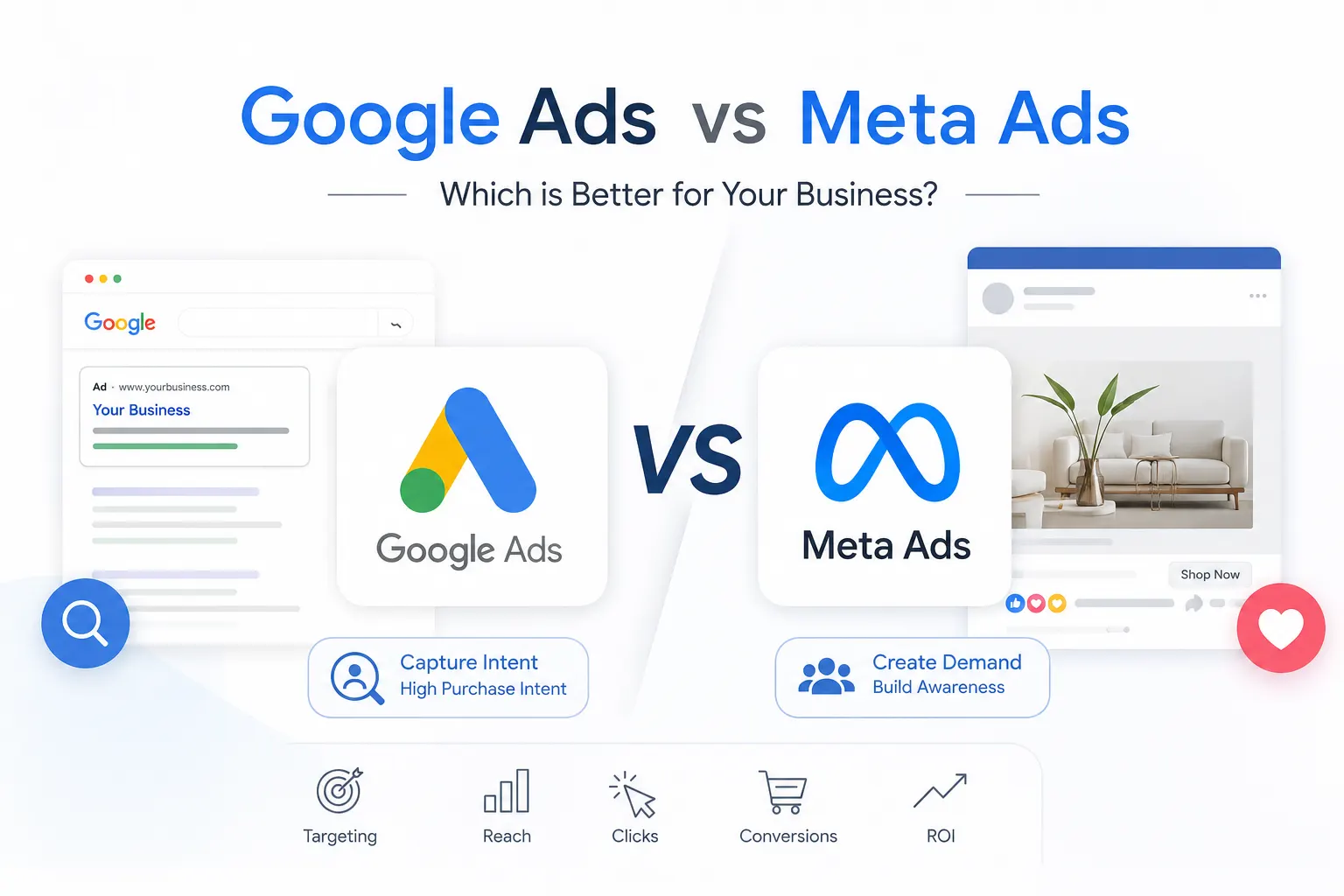
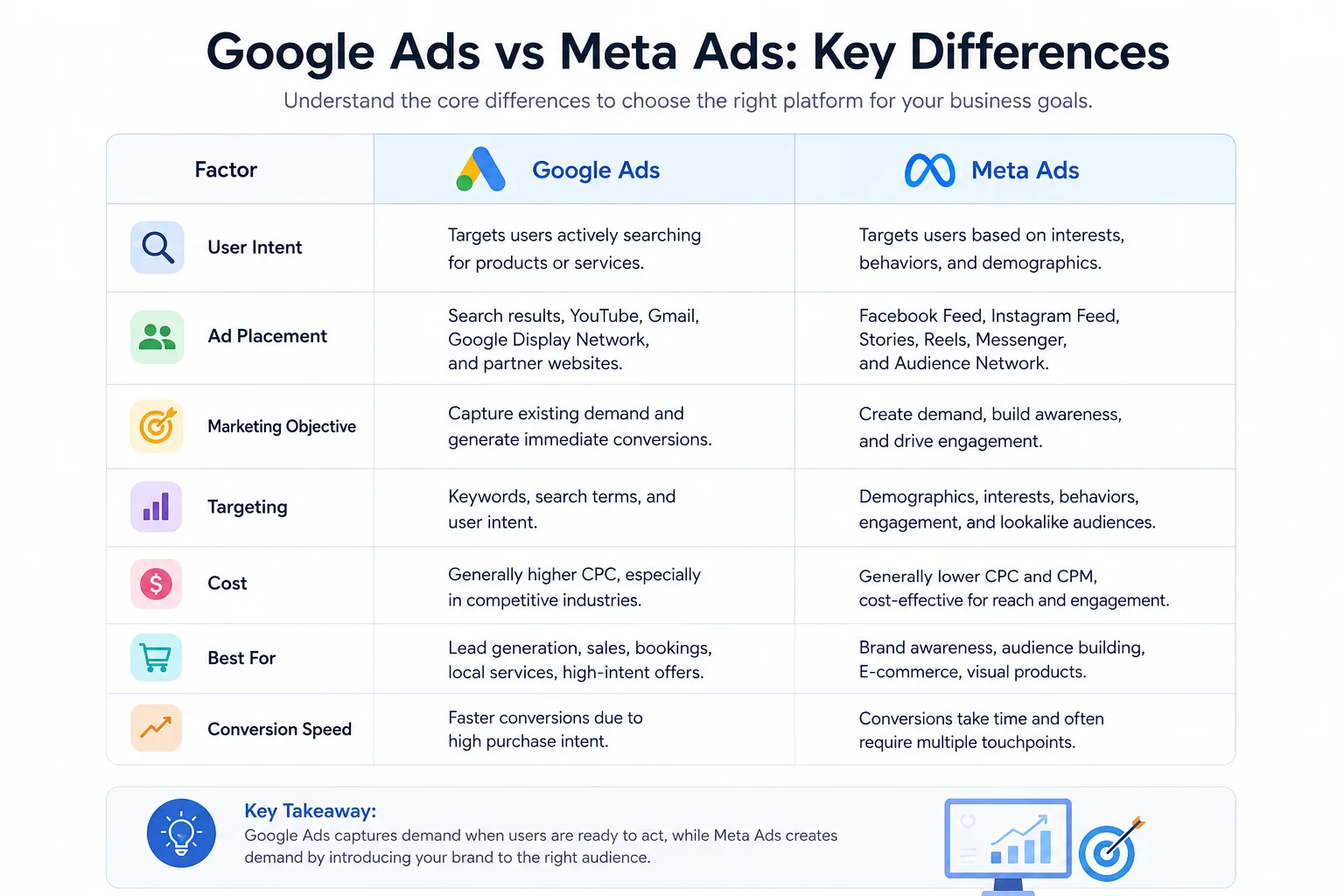
The biggest difference between Google Ads and Meta Ads lies in user intent.
Google Ads targets users who are actively searching for solutions. Meta Ads targets users based on their interests and online behavior.
Google Ads follows a demand-capture strategy. Meta Ads follows a demand-generation strategy.
Google Ads typically performs better for businesses offering services such as legal consultation, healthcare, education, real estate, software solutions, and local services because customers often search for these services before making a decision.
Meta Ads tends to perform better for fashion brands, beauty products, fitness programs, lifestyle businesses, consumer products, and e-commerce stores because visually appealing advertisements can influence buying decisions.
Another important distinction is audience targeting. Google relies heavily on keywords and search behavior, while Meta relies on demographic and behavioral targeting.
Audience Intent and Customer Journey
Customer intent plays a significant role in determining which platform will deliver better results.
Google Ads is highly effective for users in the decision-making stage. When someone searches for terms like “best digital marketing agency near me” or “buy running shoes online,” they already have a strong purchase intent.
Meta Ads is more effective during the awareness and consideration stages of the customer journey. A user may discover a product while scrolling through Instagram and become interested even though they were not actively searching for it.
This difference means Google Ads often generates faster conversions, while Meta Ads helps businesses build long-term brand recognition and customer relationships.
Successful marketers understand that customers rarely make purchasing decisions instantly. Many customers first discover a brand through Meta Ads and later search for it on Google before completing a purchase.
Cost Comparison Between Google Ads and Meta Ads
Advertising cost is another critical factor when comparing the two platforms.
Google Ads generally has a higher cost-per-click because advertisers compete for keywords with strong commercial intent. Industries such as insurance, legal services, healthcare, and finance often experience expensive keyword bidding.
Meta Ads typically offer a lower cost-per-click and lower cost-per-thousand impressions. This allows businesses to reach larger audiences with smaller budgets.
However, lower costs do not always mean better results. The real metric that matters is return on investment. A higher-cost Google Ads campaign can generate more revenue if it attracts highly qualified customers.
Businesses should evaluate cost per lead, conversion rate, customer acquisition cost, and return on ad spend rather than focusing solely on click costs.
Conversion Potential of Both Platforms
Google Ads generally delivers higher conversion rates because users already demonstrate purchase intent through their search queries.
For example, a person searching for “emergency plumber near me” is likely to contact a service provider immediately. In such cases, Google Ads become extremely effective.
Meta Ads often require multiple touchpoints before a conversion occurs. Users may interact with a brand several times through Facebook or Instagram before making a purchase decision.
Despite this, Meta Ads can be highly profitable when combined with remarketing strategies. Businesses can re-engage users who have visited their website, viewed products, or interacted with previous advertisements.
The effectiveness of either platform depends on campaign structure, targeting accuracy, landing page quality, ad creatives, and overall marketing strategy.
Industry-Wise Performance Comparison
Different industries experience different levels of success on each platform.
Service-based businesses often achieve better results through Google Ads because potential customers actively search for solutions.
E-commerce brands frequently benefit from both platforms. Google Shopping Ads capture buyers with purchase intent, while Meta Ads creates awareness and drives product discovery.
Educational institutions can use Google Ads to target students searching for courses while using Meta Ads to increase awareness among prospective learners.
Healthcare providers, law firms, and local businesses generally rely heavily on Google Ads due to strong search demand.
Fashion, beauty, fitness, travel, and lifestyle brands often perform exceptionally well on Meta Ads because visual content significantly influences customer behavior.
When to Choose Google Ads
Google Ads is the better option when your objective is generating immediate leads, sales, or inquiries from users actively searching for your products or services.
Businesses should prioritize Google Ads when they operate in high-intent industries, have strong keyword demand, and want measurable conversion-focused results.
It is also highly effective for local businesses that depend on customers searching for nearby services.
If your target audience already knows what they need and is actively looking for solutions, Google Ads usually provides the strongest opportunity for conversion.
When to Choose Meta Ads
Meta Ads is the better choice when the goal is brand awareness, audience engagement, community building, and demand generation.
Businesses with visually attractive products often benefit significantly from Meta Ads because compelling visuals can influence consumer decisions.
Meta Ads is particularly useful for startups and new brands that need exposure before customers begin actively searching for them.
It also provides powerful audience segmentation options that allow advertisers to reach highly specific groups based on interests, demographics, and behaviors.
If your business depends on storytelling, emotional connection, and visual engagement, Meta Ads can deliver excellent results.
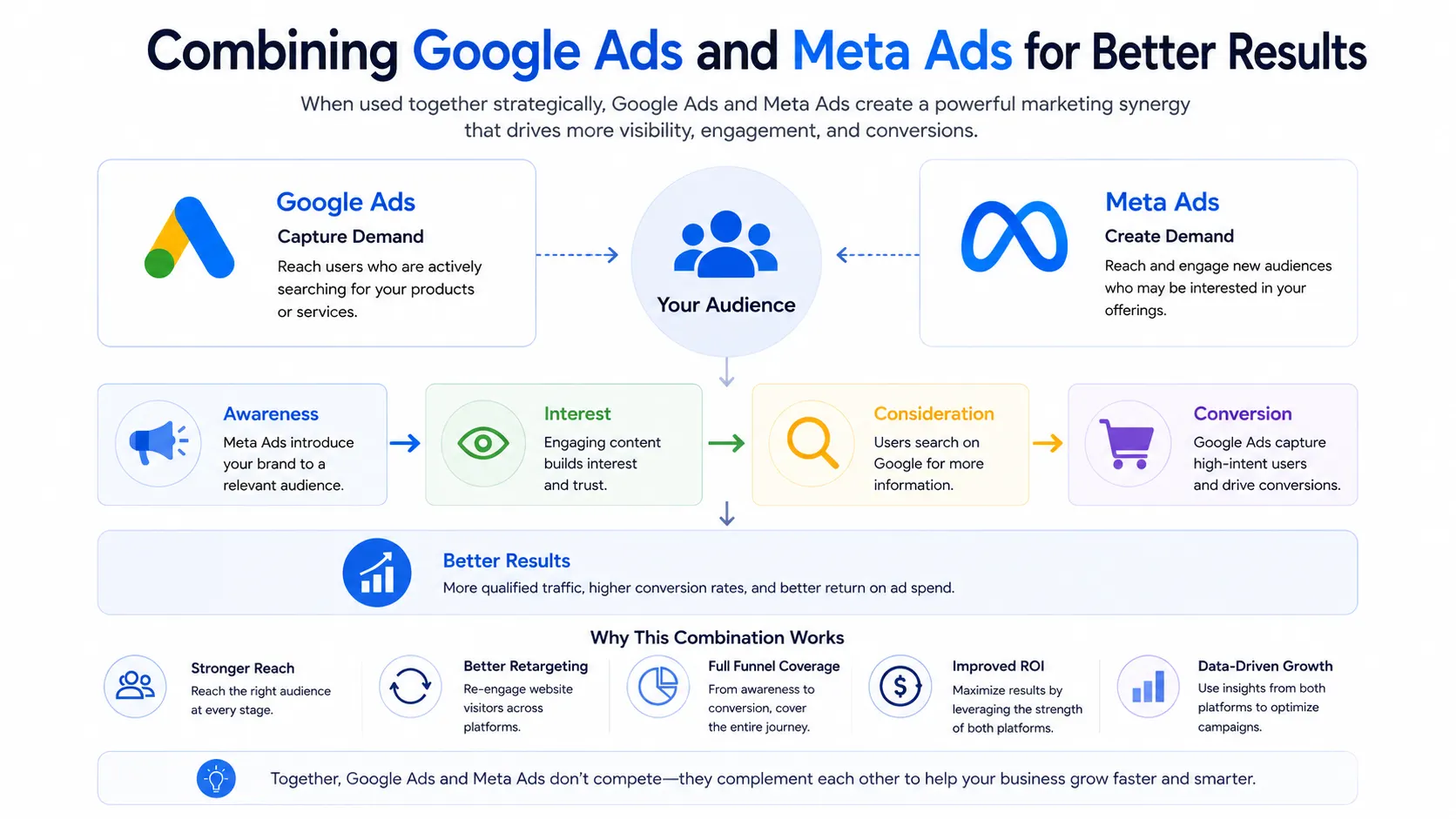
Combining Google Ads and Meta Ads for Better Results
Many businesses make the mistake of treating Google Ads and Meta Ads as competitors. In reality, the most successful marketing strategies often combine both platforms.
Meta Ads can create awareness and introduce a brand to new audiences. Google Ads can then capture users who later search for the brand or related products.
For example, a customer may first see a product advertisement on Instagram. Later, they search for reviews or pricing information on Google before making a purchase.
Using both platforms creates a complete marketing funnel that supports customers from awareness to conversion.
Businesses that integrate both advertising channels often achieve stronger brand visibility, higher conversion rates, and better long-term growth.
Challenges and Limitations
Google Ads can become expensive in competitive industries. Poor keyword targeting or weak landing pages can quickly waste advertising budgets.
Meta Ads faces increasing challenges related to audience tracking, privacy regulations, and ad fatigue. Advertisers must continuously refresh creative assets to maintain performance.
Both platforms require ongoing optimization, testing, and data analysis. Success rarely comes from launching a campaign and leaving it unchanged.
Marketers must regularly monitor performance metrics, improve targeting strategies, test creatives, and refine bidding approaches to achieve consistent results.
My Learning and Practical Understanding
Through my study of digital marketing and advertising platforms, I have developed a strong understanding of how Google Ads and Meta Ads contribute to business growth.
I learned that successful advertising is not about choosing the most popular platform but selecting the platform that aligns with business objectives, audience behavior, and customer intent.
Google Ads excels at capturing existing demand, while Meta Ads excels at creating demand. Understanding this distinction is crucial for developing effective digital marketing strategies.
I also gained valuable insights into audience targeting, campaign objectives, bidding strategies, conversion tracking, remarketing, performance measurement, and return on investment analysis.
These concepts have strengthened my ability to evaluate advertising opportunities and recommend suitable strategies based on business goals.
Conclusion
The debate around Google Ads vs Meta Ads does not have a universal winner. The better platform depends entirely on business objectives, target audience, industry, budget, and marketing goals.
Google Ads is generally the stronger option for businesses seeking immediate leads and high-intent conversions. Meta Ads is often the preferred choice for building awareness, engaging audiences, and creating demand through compelling visual content.
For most businesses, the most effective approach is not choosing one platform over the other but strategically combining both. Google Ads captures customers who are ready to take action, while Meta Ads nurtures potential customers and strengthens brand visibility.
A balanced advertising strategy that leverages the strengths of both platforms can help businesses maximize reach, improve conversions, and achieve sustainable long-term growth in an increasingly competitive digital marketplace.